Shared Tools, Lost Bills: How Small EU Shops Stop Paying Twice for the Same Gear
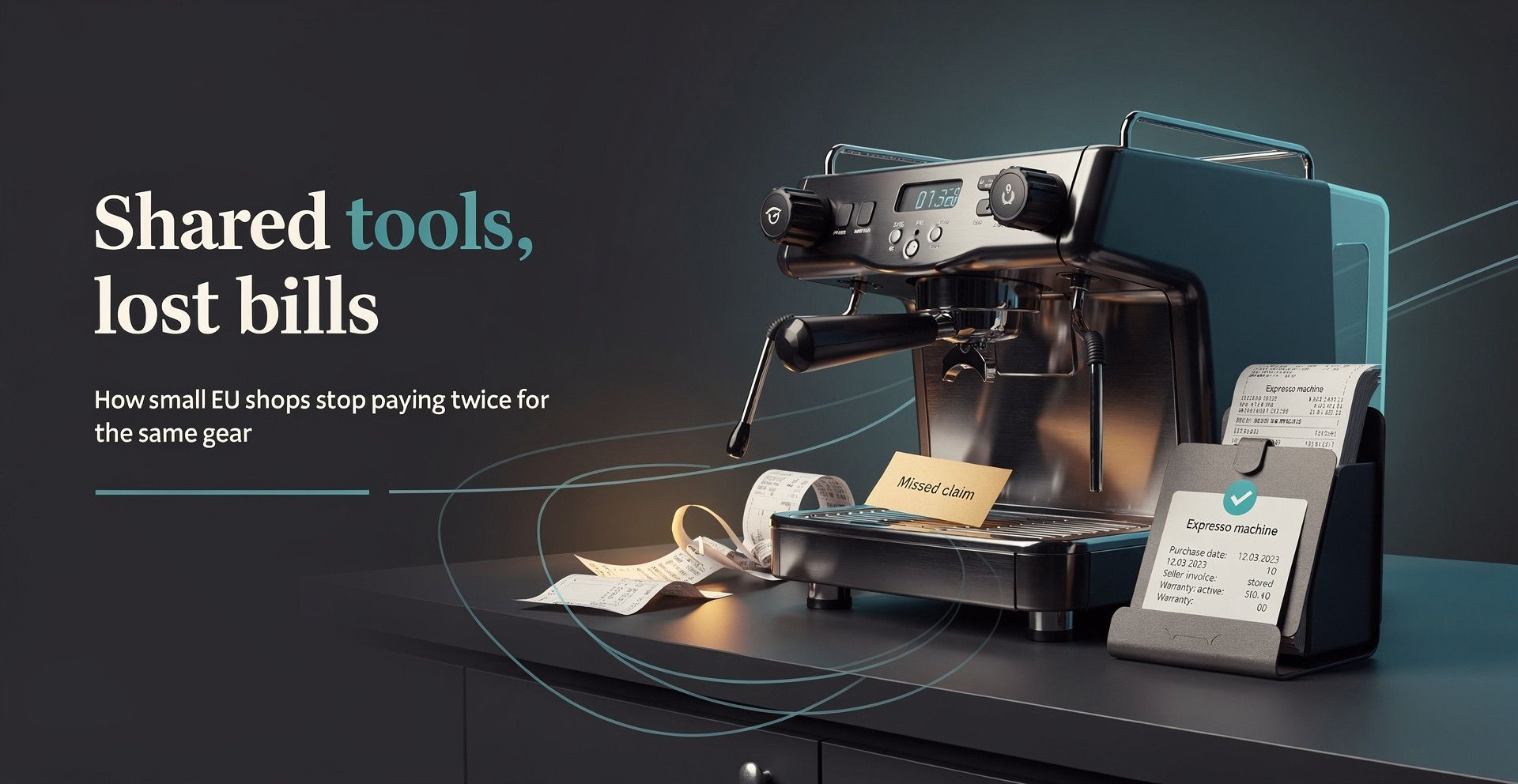
The espresso machine in a Lyon café dies on a Saturday morning. Nobody knows where the receipt is, who bought it, or whether the warranty still holds. By Monday the owner has ordered a replacement at full price, while the original fault would have been a free fix.
That scramble is normal in small shops, studios, and rentals. Everyone uses the printer, the drill, or the coffee machine, but no one owns the paperwork. The real cost of a missing receipt lands straight on the till, and staff changes wipe out whatever memory of the purchase existed.
The good news is that this is a repair or replace decision you can win most of the time. One shared record per item, set up in an afternoon, turns the next breakdown into a quick claim or a planned repair instead of a repeat purchase.
Why shared gear loses its paperwork first
Home buyers lose receipts in drawers. Shops lose them faster, because the person who bought the item is rarely the person holding it when it breaks. A Berlin studio manager inherits a printer bought by someone who left a year ago. An Amsterdam bike rental adds tools bought cash at a market stall. Each handover thins the story until only the object remains, with no date, no proof, and no coverage.
Shared use without shared records is the core problem. When five people use one machine, each assumes someone else kept the bill. Suppliers and repair shops then ask the one question that ends claims: can you prove the purchase date? Without it, warranties stay theoretical and every fault looks like a new purchase.
Small teams feel this harder than households. A household rebuys one kettle. A café, salon, or workshop rebuys workhorses worth hundreds of euros each, and downtime costs customers too.
A Tuesday in Lyon: what the record changes
Take Marta, who runs a 12-seat café below Croix-Rousse in Lyon. Her two-group espresso machine was bought in March 2024 for about €2,400 by her former business partner. In June 2026 the pump failed mid-service. The partner had left the year before, and the paper receipt had gone with the old till drawer.
Because her shift lead Karim kept one record per machine, the story took ten minutes instead of ten days. Purchase date, seller invoice photo, and warranty terms were in one place. The seller accepted the claim the same afternoon, the repair was covered, and the machine was back by Friday. Without that record, Marta would have faced the full replacement cost plus a weekend of lost sales. The difference was never the machine. It was the proof.
What EU buyers get by default, and what they must prove
Goods bought retail in the EU usually carry a minimum 2-year legal guarantee, which means the seller must repair or replace faulty goods at no cost, and some countries add extra protection on top (Your Europe guarantee rules). A commercial warranty from the maker can add more, but it never replaces that baseline.
Here is the catch that matters for shops: the right exists on paper, but using it needs proof of purchase. Date, seller, and price turn a vague complaint into a claim the seller must answer. Keep that proof and the guarantee works for you. Lose it and you pay twice, once for the item and once for its replacement.
The same logic applies to repairs. EU rules increasingly push sellers and makers toward repair over replacement, and a shop that can show purchase date plus repair history gets faster answers from any service desk.
The one-record-per-item setup
You do not need new software habits across the whole team. You need one place where each item has its own record, and one person who owns keeping it current.
What to capture for each item
Four things, photographed or noted the day the item arrives: purchase date and price, seller and receipt photo, model and serial number, and warranty terms with expiry. Add a fifth over time: every repair or service note with its date. That takes minutes per item and answers every future question in seconds.
Keep personal and shop items in separate spaces if you mix them. A drill you use at home and in the workshop should show which side each receipt belongs to, so costs and claims never blur.
Who keeps the record when everyone shares it
Name one keeper. In a café it might be the shift lead, in a studio the office manager, in a rental shop whoever signs for deliveries. The rule is simple: nothing new enters service until its record exists. New hires learn it on day one, which means staff turnover stops erasing your ownership history.
When something breaks, the keeper pulls the record and checks coverage before anyone calls a repair shop or orders a replacement. That single pause is where the savings happen.
Repair first, rebuy last
With records in place, most breakdowns follow the same calm path. Check the warranty, check the repair history, then compare the repair quote against replacement cost and remaining life. Teams that track this stop junking machines with years left in them, which is also how small shops cut waste without preaching about it.
Over a few years the effect compounds. Fewer surprise purchases, faster claims, and a clear story for every machine you get full value from. Buyers of your used gear pay more for the same reason: dated proof beats promises.
Conclusion
Shared gear will keep breaking. That part you cannot change. What you can change is whether each breakdown costs you a phone call or a full repurchase. If you run a small shop anywhere in the EU, HoldMyBill gives you one shared place to store bills, warranties, and repair history per item, so the next failure ends with proof in hand.
HoldMyBill links:
- Website: HoldMyBill Website
- iOS App Store: HoldMyBill on Apple App Store
- Android Play Store: HoldMyBill Asset Manager on Google Play
- Support Page: HoldMyBill Support