Right to Repair Is Here. Now What Do You Actually Do With Your Receipts and Warranties?
Picture this: your washing machine stops mid-cycle on a Sunday evening. You vaguely remember something about a one-year warranty or was it two? You check the drawer. Nothing. You search your inbox. You find 47 promotional emails from the store, but not the actual receipt.
So you call the service center. They ask for the purchase date and model number. You don't have either. The repair ends up coming out of your pocket even though you might have been fully covered.
This happens more often than anyone admits. And the frustrating part? The law is actually on your side now. Your paperwork just isn't.
That's exactly the problem HoldMyBill was built to solve.
What Right to Repair Actually Changes (In Plain Language)
From "Throw It Away" to "You're Allowed to Fix It"
For years, getting a device repaired meant going back to the manufacturer or being told repair simply wasn't an option.
Right to Repair is a growing global movement that changes this. It gives consumers and independent repair shops better access to spare parts, tools, and product documentation. The EU's Right to Repair Directive, adopted in 2024, takes full effect in July 2026 requiring manufacturers to offer repair services at reasonable prices. In the US, over 40 Right to Repair bills were proposed or passed across at least 20 states in 2025 alone.
The motivations are both environmental and financial:
- Less electronic waste ending up in landfills
- Longer product lifespans, saving you real money
- More competition in repair markets, driving costs down
- A shift toward a circular economy buy once, maintain well, replace less
But the Law Doesn't Organize Your Paperwork
Here's the gap no legislation can close: repair shops still need proof from you when you bought the product, its model and serial number, and whether it's still under warranty.
Right to Repair gives manufacturers fewer excuses to say no. But if you arrive without documentation, the right stays theoretical. You have to show up with receipts, warranty terms, and service history. Without that, you're working from memory and memory is unreliable when money is on the line.
Key takeaway: The law shifts leverage to consumers. Your documentation converts that leverage into actual savings.
The Uncomfortable Truth: Your Receipts and Warranties Are Probably a Mess
Where Your Proof Is Hiding Today
For most people, product documentation is scattered across:
- Email inboxes buried under newsletters and spam
- Paper receipts in kitchen drawers, wallets, or old shopping bags
- Photos buried deep in a camera roll or WhatsApp
- Retailer apps, loyalty accounts, or brand portals
- Screenshots saved to random phone folders
This fragmentation creates silent loss coverage you paid for but can never actually use, because the proof no longer exists in any usable form.
Real Stories of Missed Coverage
These aren't rare edge cases. They're everyday:
- The dishwasher scenario: Appliance breaks after 13 months. You think the warranty was 12 months but it might have been 18. Without the warranty document, there's no way to check. Repair is fully out of pocket.
- The credit card benefit you forgot: Many premium cards offer extended purchase protection. But those benefits require the original invoice. Without it, the coverage quietly expires, unused.
- The serial number you never saved: A device needs warranty repair but the manufacturer asks for the serial number. It's on a sticker you peeled off. The claim stalls.
If any of these sound familiar, you're not disorganized you just haven't had a system. That's what we'll fix next. (Also see: A Simpler Way to Manage Your Warranties and Bills for a practical starting point.)
What Actually Matters on a Receipt or Warranty (So You Can Claim Repairs)
The Essential Data Points to Capture
When a repair claim comes up, these are the five things you almost always need:
- Purchase date and proof of payment confirms ownership and when the warranty started
- Product name, model number, and serial number required by virtually every repair center
- Seller or retailer details relevant if the dispute escalates
- Warranty period and key conditions how long, what's covered, repair vs. replacement terms
- Service history previous repairs, replacements, or reported issues
If you have these five things for each product, you can walk into any repair conversation with full confidence.
Why "I'll Just Search My Email Later" Is Not a System
Email search feels like a safety net until you actually need it. Accounts get hacked. Emails get deleted. Spam filters eat confirmation messages. And at the exact moment something breaks, the last thing you want is to scroll through years of inbox clutter.
The risk isn't just friction. It's the very real chance you won't find what you need, when you need it most.
With HoldMyBill: Every document invoice, warranty PDF, serial number lives in one searchable place, attached to the specific product it belongs to. No inbox archaeology. No panic.
From Piles of Paper to an Ownership System (Not Just a Folder)
There's a big difference between storing documents and actually having a system:
| File Locker | Ownership System |
|---|---|
| Static storage | Active structure with timelines |
| You dump files in | You find the right file in seconds |
| No reminders | Warranty expiry alerts |
| No context | Full product history per item |
What you want is an ownership OS a single place where every product with a bill or warranty gets a complete, searchable record. Think of it as a dedicated home for each thing you own, not a pile of PDFs.
In HoldMyBill, each product gets its own record purchase date, invoice, warranty document, serial number, and a timeline of every repair or service done. It's not a folder. It's a living history of everything you own.
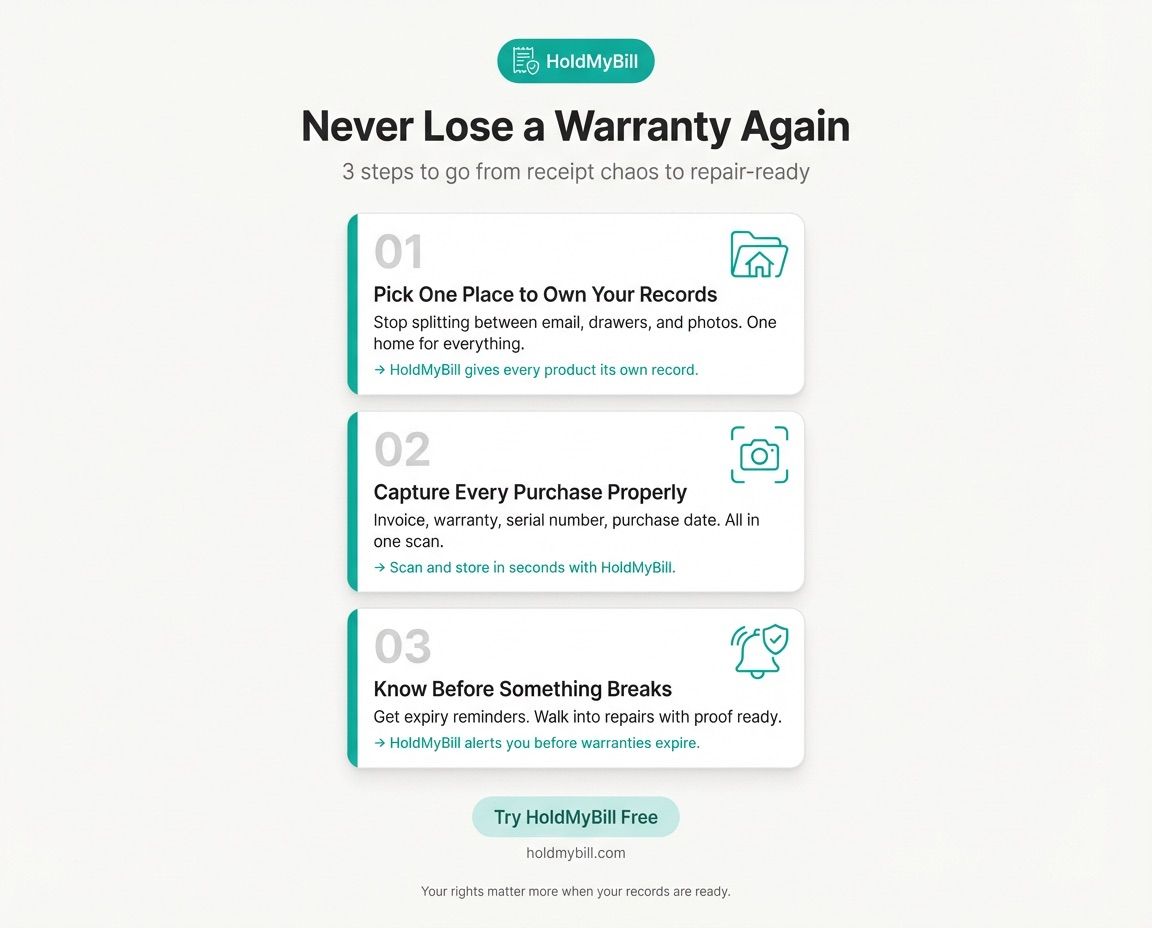
Step 1 – Decide Where Your Ownership Lives
Pick one place and commit to it. It must be one place splitting receipts between Google Drive, email, and a physical binder recreates the same problem you started with.
For most people, a digital system works best because it's searchable, accessible on any device, and can send reminders before warranties expire.
With HoldMyBill: Your ownership home is ready from the moment you sign up. Add a product, upload the invoice, enter the warranty period done. Start with your first product here.
Step 2 – Capture Your Next 5 Purchases Properly
Don't try to fix your entire ownership history in one overwhelming weekend. Start with your very next purchase and the four after that.
For each one, capture:
- Invoice image or PDF
- Warranty card or document
- Serial number and model
- Where the product lives in your home
This forward-looking habit builds momentum quickly. Within a few months, the important things are covered without guilt.
With HoldMyBill: Scan the invoice with your phone camera, type in the serial number, and the record is complete in under two minutes. The app keeps it structured so you never have to think about it again.
Step 3 – Slowly Backfill the Big Stuff You Already Own
Once the habit is in place, work backwards but only on what matters most:
- Items that would genuinely hurt to replace (TV, refrigerator, laptop)
- Products with extended warranties or service contracts
- Anything currently under a subscription repair plan
You won't find every old receipt. That's okay. Recover what you can from retailer accounts, email search, and bank statements and move forward. The goal isn't a perfect history; it's a system that works from today.
With HoldMyBill: Even partial records are useful. Add what you have a photo of the product, an approximate purchase date, a note about the warranty and build from there. Something is always better than nothing.
How Right to Repair + Better Records Change Everyday Decisions
Before You Replace, You Now Have Three Quick Checks
The next time something breaks, don't reach for a replacement order before asking:
- Is it still under warranty or consumer law coverage? Right to Repair laws are expanding the window in many places.
- Are parts and independent repair options now available? Recent legislation means more products qualify for third-party repair.
- What does the service history say? A one-time failure is very different from a pattern of recurring issues.
These three questions answered with actual records turn a stressful decision into a logical one. HoldMyBill shows you the full product timeline so you can answer all three in seconds.
Repair, Refurbish, or Replace With Receipts to Back Each Choice
When you have documentation, the repair-vs-replace decision stops being a gut call:
- Repair if it's under warranty or the repair cost is well below replacement value
- Refurbish or swap parts if the device is older but the market now supports it Europe's refurbished tech market is growing fast in 2026
- Replace only when repair is genuinely uneconomical and then, capture that new purchase in HoldMyBill correctly from day one
Choosing repair first isn't just good for your wallet. It directly supports the circular economy the broader shift toward reducing e-waste and keeping products in use longer.
Building a Repair-Ready Home in 30 Minutes a Month
A Simple Monthly "Receipts and Warranties" Ritual
A light monthly check-in is all you need:
- Add new purchases from the past 30 days invoice, warranty, serial number
- Check for upcoming warranty expiries schedule service or register claims before the window closes
- Log any issues, fixes, or maintenance done that month this builds your product history naturally
Thirty minutes once a month prevents hours of panic later.
With HoldMyBill: The app sends you reminders before warranties expire, so the monthly check-in is mostly just adding new items. The hard part is already handled for you.
What This Looks Like Over a Few Years
After 12–18 months of consistent use, something quietly shifts:
- You stop losing warranties you paid for
- You stop replacing products that were still covered
- You walk into any repair shop or email any support line with purchase dates, proof, and history ready
No scrambling. No guessing. No out-of-pocket repairs that were technically someone else's responsibility.
Common Questions About Receipts, Warranties, and Right to Repair
"What if I've Already Lost Half My Receipts?"
That's completely normal most people have. Here's what you can recover:
- Retailer accounts (Amazon, Flipkart, official brand stores) often keep order history for years
- Bank and card statements can confirm purchase dates and amounts
- Email search with terms like "invoice," "order confirmation," or the product name can surface buried documents
For everything you can't recover, simply move forward. Add what you have to HoldMyBill, and start building clean records from today.
"Do I Need to Understand Every Legal Detail of My Warranty?"
No. You don't need to be a legal expert.
What you need is the warranty document accessible when something goes wrong, the key dates (start and end), and a basic sense of what's covered. HoldMyBill keeps the full warranty document attached to the product record so when support asks, you open the app, not a filing cabinet.
Your Rights Matter More When Your Records Are Ready
Right to Repair is a genuine win for consumers. Laws are shifting, manufacturers have fewer excuses, and repair is becoming the default in more product categories. But that shift only benefits you if you can prove what you own, when you bought it, and what coverage applies.
The everyday leverage doesn't live in legislation it lives in your receipts, your warranty documents, and your service history.
If you want to skip the setup work entirely, HoldMyBill is free to try. Add your first product in under two minutes and see what an organized ownership record actually feels like. That's how the law starts working for you.
Further reading: