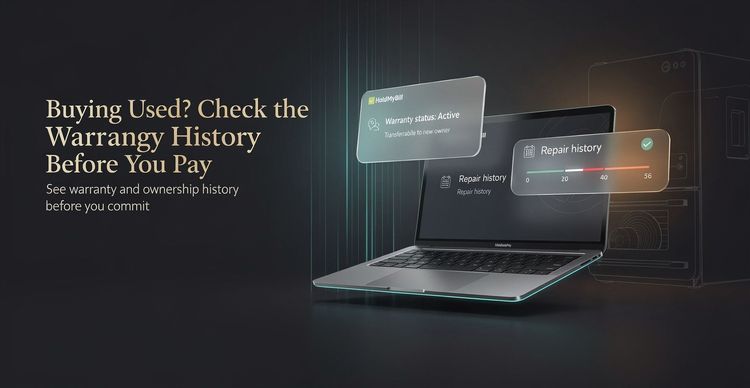
Why Most Warranties Go Unused — And What Actually Keeps Them Valid
Most warranties lapse because the paperwork got lost, not because coverage ran out. Here is why structured ownership records are the missing piece for consumers and brands.
The Coverage Window Most People Miss
Most manufacturer warranties end at year one or two. That is the moment most people stop thinking about coverage. It is also the wrong moment.
The highest-risk period for appliances and electronics is years two through five. Roughly 60% to 80% of major appliance claims occur after OEM coverage ends. That is when sealed systems fail, control boards fry, and compressors quit. Those are also the years when extended coverage and repair decisions matter most.
If you cannot prove purchase date, serial number, or service history, optional coverage often disappears by default. You do not lose the warranty because time passed. You lose it because you could not show you were still inside it.
Organized records change that window from guesswork to a clear decision.
If you want a quick readiness check before anything breaks, try the Extended Warranty Analyzer.
Why Warranties Expire Unused
The reasons are boring, which is why they compound.
Paperwork disappears. Receipts land in email folders and get buried under order confirmations and newsletters. Physical receipts go into drawers, bags, or glove compartments. Warranty cards are rarely filed with the proof of purchase that actually matters.
Policy literacy is thin. Most buyers never read the exclusions, registration deadlines, or proof-of-purchase requirements buried in the fine print. A single missed deadline can turn a valid claim into a denied one.
Then there is multi-party friction. The consumer has the product. The brand has the policy. The retailer has the transaction record. Nobody has the complete timeline in one place.
The result is predictable: claims denied, coverage missed, repair costs absorbed entirely by the owner.
For a plain-language walkthrough of the traps that show up most often, see How to read a warranty card without missing the fine print.
The Actual Cost
The cost is concrete.
An $800 appliance needs a $150 repair. The warranty expired two months ago because the paperwork was never found. That is not bad luck. It is an organization problem dressed up as forgetfulness.
Scale that across electronics and appliances and the numbers are material. Electronics claim payouts average around $500. Appliance claim payouts average around $3,500. When brands cannot match claims to verifiable ownership data, those costs become either unrecovered warranty spend or denied claims that turn into returns, exchanges, and brand damage.
On the consumer side, the exposure is simpler: full replacement cost instead of covered repair.
What Changes When You Track the Product, Not Just the Paper
The fix is not a filing system. It is a product record.
Keep one place per product: purchase date, seller, amount, serial number, warranty length, warranty terms, and later service history. That record becomes the proof layer for claims, resale, repairs, and even insurance documentation.
It also becomes the foundation for later decisions. When you know the purchase date, warranty window, and service history, the repair-versus-replace question stops being a guess. Resale becomes a conversation with evidence instead of hope. Buy-backs and trade-ins become possible because ownership history is verifiable.
This is not an enterprise system. It is just better ownership habits with real downstream value.
For the broader system view, see Asset Lifecycle Management for Everyday Products.
When It Matters Most
There are moments when organized records pay off immediately.
Warranty claims require proof of purchase and ownership within a defined window. Resale or hand-me-downs depend on documented history to earn buyer trust and higher offers. Home insurance or renter’s claims need verification that is easy to provide when everything is filed by product. Even tax deductions for home office equipment depend on having the right documentation ready.
In each case, the question is the same: can you prove what you own, when you bought it, and what coverage or history it has?
A Calm Alternative to Scattered Files
You do not need another inbox. You need records that follow the product, not the purchase moment.
A single timeline beats a folder of unrelated PDFs because it answers the only question that matters when something fails: what do I own, when did I buy it, and what coverage or history does it have?
The entry barrier should be zero. Start with one product, add more over time, and let the system grow with your actual ownership instead of forcing a bulk migration that never finishes.
HoldMyBill links:
- Website: HoldMyBill Website
- iOS App Store: HoldMyBill on Apple App Store
- Android Play Store: HoldMyBill Asset Manager on Google Play
- Support Page: HoldMyBill Support