Repair or Replace? A Practical Formula for Everyday Products in Europe
In Europe, you don’t have to choose between “buy new” and “do without.” EU consumer rules give you a minimum 2‑year legal guarantee on most goods, and if something is faulty you can normally ask first for repair or replacement instead of a refund. At the same time, the EU’s right‑to‑repair push is making spare parts, repair information, and independent repair services more accessible across member states. europe-consommateurs
This means the most valuable decision you make as a consumer is not emotional; it is financial, practical, and legal. A broken phone, coffee machine, washing machine, or vacuum cleaner should be judged by a simple formula: repair cost, warranty status, age, and reliability risk. eea.europa
If you treat every broken item like a small investment decision, you can extend product life, reduce waste, and still protect your budget.
👉 Want to see how this fits into your broader ownership strategy?
Read our guide: Asset Lifecycle Management for Personal Belongings.
How EU rules shape your choice
Under EU consumer law most purchases of defect goods come with a statutory guarantee of at least 2 years, during which you can typically request repair or replacement without extra cost. Retailers and manufacturers may offer additional commercial warranties on top of this, but the legal guarantee always applies. europa
If a problem appears within the guarantee period, you can usually ask for:
- Repair – preferred remedy in many cases, especially if the fault is minor.
- Replacement – if repair is impossible, disproportionate, or not carried out within a reasonable time.
- Price reduction or refund – only if repair or replacement are not feasible. europe-consommateurs
That’s why “repair vs replace” is not just about the product: it’s about your rights as a European consumer. If you still have proof of purchase, warranty documents, and service history, you can make a much better decision and avoid paying for a repair that should have been covered by the guarantee. europa
👉 For deeper context on how to track those documents, see our post: Get More Value Out of Everything You Own.
A simple formula for European households
Instead of guessing, use this four‑variable framework to decide whether to repair or replace:
1. Is the item still under legal guarantee or commercial warranty?
If the product is still within its legal guarantee (minimum 2 years in most EU countries) or an active commercial warranty, the default move should usually be repair or replacement at no extra cost. That’s the first lever in your favor. europe-consommateurs
If the item is already out of warranty, the repair becomes a pure cost‑benefit decision.
2. Is the repair price clearly below the cost of a new product?
A common rule of thumb is:
If the repair cost is more than about 30–50% of the price of a comparable new product and the item is already old, replacement is often more sensible.
If the repair is cheap, parts are easy to find, and the product is still in good overall condition, repair usually wins. sciencedirect
3. Are spare parts and repair services easy to find?
The EU’s right‑to‑repair rules are designed to make spare parts, repair manuals, and independent repair shops more available for electronics and appliances. That means devices that once seemed “disposable” are now worth considering for repair, especially if you can: facebook
- find a local service provider,
- source a reasonably priced part, or
- use a manufacturer‑approved repair channel. linkedin
4. Is the product likely to fail again soon?
If the same fault keeps coming back, or if the product is clearly worn out (noisy, slow, inconsistent), the long‑term reliability risk goes up. In those cases, replacement may be the smarter long‑term play, even if the current repair looks cheap. eea.europa
Everyday examples from European homes
This formula works especially well for common household products that people keep for years, such as:
- Phones and laptops – repair screens, batteries, or ports if the device is relatively new and the fix is affordable.
- Washing machines and dishwashers – seal or pump repairs can be worthwhile if the machine is under 5–7 years old and the part is cheap.
- Vacuum cleaners and coffee machines – simple mechanical or motor issues may be worth fixing if the product is still in good shape.
- Bicycles and small appliances – many EU‑style bikes and kitchen tools are built to last and benefit from routine maintenance and timely repairs. eea.europa
In practice, people often over‑replace when they don’t have clear records of purchase date, warranty status, and past repairs. That’s where structured ownership data turns “repair vs replace” from a stress moment into a calm decision.
👉 For a deeper look at how to track repairs and ownership over time, see: Asset Lifecycle Management for Everyday Products.
Why documentation changes the answer
Most “bad” ownership decisions happen because the owner lacks the paperwork: no invoice, no warranty date, no service history, and no clear idea of replacement cost. European consumer guides stress that warranty and guarantee rights matter, but you still need proof of purchase and service records to use them effectively. eea.europa
If you track:
- purchase date,
- warranty expiry,
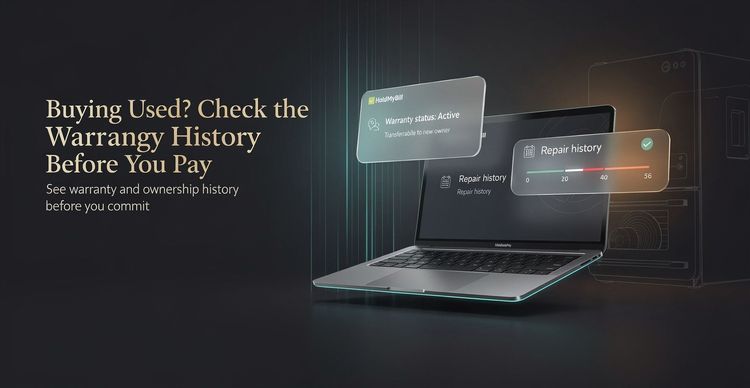
- repair history, and
- estimated replacement cost
then every repair quote becomes a data point in a long‑term decision. You can compare:
“Is this repair a small, predictable step on the product’s lifecycle, or a sign that it’s time to move on?”
This kind of clarity is exactly what the EU’s push toward longer product lifespans and repair‑first thinking is designed to support. facebook
👉 Learn how to build a simple system that fits this mindset in our guide: How to Solve Warranty Tracking Problems Effectively.
How to turn this into a habit
If you want to make “repair vs replace” decisions faster and less stressful, start with a simple, three‑step habit:
- Record every major purchase with date, purchase price, warranty length, and where you kept the receipt or digital proof.
- Add a short note every time you repair the item, including the cost, date, and what fixed.
- Compare the next repair against your rule‑of‑thumb (e.g., 30–50% of replacement cost) and your product’s age before deciding.
Once you do this consistently, you start treating your belongings more like a portfolio of assets than a pile of random stuff. You’ll see patterns in what tends to break, how long warranties actually last, and when it’s smarter to invest in a repair or upgrade.
Take the next step with HoldMyBill
Repair‑vs‑replace decisions are easier when you have the right data at your fingertips. HoldMyBill helps you track receipts, warranties, service history, and product age in one place, so you can apply this formula without digging through drawers or email inboxes.
Next steps for you:
- Try the HoldMyBill app to centralize your ownership data.
- Use the Smart Ownership Guide as a reference for building a simple, repeatable ownership system.
- When something breaks, pull up the asset in HoldMyBill, check the warranty, and ask: “Does this repair make sense for me, my wallet, and my rights as a European consumer?”
By combining EU‑friendly rules, practical repair data, and a simple decision formula, you can make smarter “repair or replace” choices—and get more value out of everything you own.