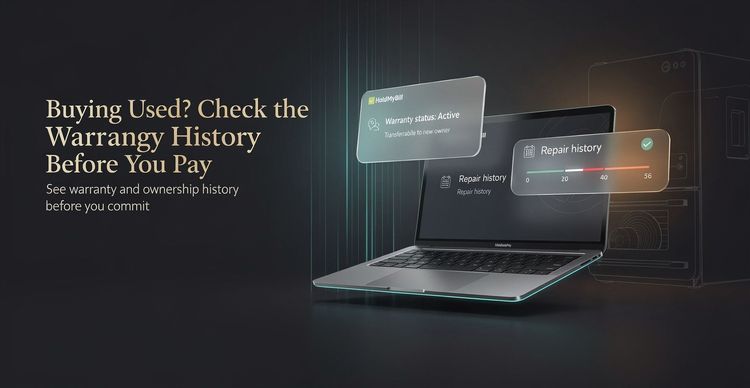
How Product History Boosts Your Resale Value
When you sell a phone, laptop, or appliance, buyers aren't just buying the item. They're buying confidence that it's genuine, well-maintained, and fairly priced. A clear product history is the fastest way to build that confidence and get a better price.
Why resale value depends on trust
Buying second-hand has gone mainstream. People want to save money and reduce waste. But every transaction starts with the same question: "Can I trust this?"
Buyers worry about hidden damage, counterfeits, missing accessories, or products that were never cared for. When there's no proof, they assume the worst. They negotiate harder, lower their offers, or skip your listing entirely. Documented product history shrinks that risk. It shows where the product came from, how it was used, and how it was maintained. Your listing goes from "maybe" to "safe bet."
What "product history" really means
Product history is the complete record of your relationship with an item from purchase day to the day you sell or discard it.
It usually includes:
- Proof of purchase – Original invoice or digital receipt with store, date, price, and payment details
- Warranty information – Manufacturer warranty, store warranty, extended service contracts, with start and end dates
- Service and repair history – Records from authorized service centers, replaced parts, previous claims or fixes
- Accessories and packaging – Original box, manuals, chargers, and other included items
- Ownership notes – Usage patterns, major issues, relevant upgrades (like extra RAM in a laptop)
HoldMyBill turns scattered bills, PDFs, and paper into structured ownership records so each product has a single, clear timeline.
How product history boosts your resale value
It builds instant buyer confidence
Showing an invoice, warranty details, and service records answers the buyer's most important questions before they ask. Proof of purchase confirms the item is legitimate. A clear service history shows you didn't ignore problems you fixed them.
That confidence translates into a willingness to pay more, especially for high-value electronics and appliances.
It justifies a higher asking price
In car markets, factory-backed warranties and service records drive higher resale values because they reduce risk for the next owner. The same logic applies to phones, laptops, TVs, and other electronics: when you can show proof of careful ownership, your asking price feels justified instead of arbitrary.
If you're selling two similar devices but only one comes with receipts, warranty proof, and repair history, buyers will almost always pick the documented one even at a higher price.
It speeds up your sale
Listings that look "complete" perform better in crowded marketplaces. When you can write "Invoice, warranty documents, and service records available," your item stands out from vague, one-line descriptions.
Buyers decide faster because they don't have to chase you for information. Fewer back-and-forth messages, shorter time to close.
It reduces disputes and lowball offers
Many disputes and lowball offers come from missing information. Without documentation, buyers question:
- The true age of the product
- Whether it's still under warranty
- What exactly has been repaired
- Whether the item is authentic
A clear product history answers all of this up front, which reduces misunderstandings and gives you more leverage when rejecting unrealistic offers.
Types of product history that matter most
Proof of purchase: your foundation
Receipts and invoices prove you're the legitimate owner, when and where you bought the item, and the original price and model details.
Some platforms and payment providers may request proof of purchase in case of disputes, especially for electronics and premium items.
Warranty coverage and remaining validity
An item with an active warranty is easier to sell because the next owner knows they're partially protected if something goes wrong. Extended warranties and service contracts are a proven value booster for cars, and the same is increasingly true for expensive electronics and appliances.
Being able to say "8 months warranty left" and prove it is a powerful selling point that often justifies a higher price.
Service and repair history
Buyers aren't necessarily scared by repairs. They're scared by unknown repairs. A transparent history from authorized service centers can be more reassuring than a claim of "never repaired" with no proof.
Examples that help your case:
- Service invoices from official repair partners
- Records of part replacements (battery, display)
- Proof that major issues were resolved professionally
This is standard practice for cars and is becoming more important for premium electronics as their resale markets mature.
Accessories and original packaging
Having the original box, charger, cables, and manuals signals that the item was valued and looked after. For some buyers, complete packaging is non-negotiable, especially for high-end gadgets, cameras, and audio gear.
This completeness lets you nudge your price up and makes your listing feel more "like new" than "used."
Real-world examples across categories
Phones, laptops, and gadgets
For phones and laptops, competition is fierce, and buyers quickly scan for trust signals. If your listing includes a clear photo of the invoice, warranty card or digital warranty proof, and screenshots or PDFs of service history, you'll usually attract more serious buyers than a similar device without those documents.
This matters even more for premium gadgets where authorized service center receipts strongly increase perceived value.
Home appliances and electronics
Washing machines, refrigerators, TVs, and ACs are expensive to repair, so buyers care deeply about maintenance. Being able to show purchase invoice, warranty registration or extended coverage proof, and any service visits (gas refills, compressor changes, board replacements) gives buyers confidence that they're not buying a future repair bill.
Vehicles and other high-value assets
In vehicle markets, documented service history, transferable warranties, and protection plans are standard levers for increasing resale value. While HoldMyBill focuses on everyday products, the same principle holds: when significant money is involved, documentation matters.
Even for bikes, e-scooters, or high-end tools, clear records separate "random second-hand item" from "well-cared-for asset with proof."
The hidden cost of missing product history
Losing bills, throwing away warranty cards, or never saving service receipts doesn't hurt immediately. But it quietly erodes your future resale value.
Common consequences:
- Buyers assume more risk and push your price down
- You can't easily prove authenticity or age, so serious buyers walk away
- Some resale or trade-in programs refuse items without proof of purchase
- You miss warranty or insurance claims because you can't show documents on time
Over years of purchases, this can easily add up to hundreds or thousands in lost value from products you already paid for.
How to build strong product history from day one
You can start building product history the same day you make a purchase. You just need a simple, repeatable system.
1. Capture everything at purchase
Right after you buy something:
- Save or scan the invoice/receipt (photo, PDF, or email forward)
- Record the product name, model number, serial number, and purchase date
If you skip this step, fixing it later is possible but always more painful.
2. Track warranties and expiry dates
Add warranty details as soon as you have them:
- Manufacturer warranty length and start date
- Store or extended warranty info
- Coverage scope (accidental damage, on-site service)
Set reminders before expiry so you can book service visits, claim replacements, or decide whether to extend coverage before it's too late. If you're not sure whether an extended warranty is worth buying, the Extended Warranty Analyzer can help you figure that out.
3. Log repairs and maintenance
Every time something is repaired or serviced:
- Save the service invoice or job card
- Note what was fixed, when, and by which service provider
Over time, this becomes a timeline that future buyers can trust and that you can use to decide whether to repair, replace, or resell. Not sure which way to go? Our Repair or Replace Calculator runs the numbers for you.
4. Keep everything in one structured place
Random photos in your gallery or a "Bills" folder in email are better than nothing, but they're hard to search when something breaks or when you're rushing to sell.
A dedicated ownership/warranty management app keeps:
- Assets organized by product, not by file name
- Warranties, receipts, and service records linked to each item
- Expiry dates and important events visible at a glance
That's exactly the problem HoldMyBill is designed to solve.
How HoldMyBill helps you preserve resale value
HoldMyBill is an asset lifecycle management app built to manage what you own from purchase to resale, not just to store receipts.
One asset, one complete record
When you add a product to HoldMyBill, it becomes a structured asset record with:
- Receipt or invoice
- Warranty details and expiry dates
- Service and repair history
- Important dates and notes
Instead of spreading documents across drawers, inboxes, and gallery photos, everything lives in one clean timeline per product. Learn more about how HoldMyBill manages warranties in one place.
From purchase to repair to resale
HoldMyBill follows the full lifecycle of your products:
- At purchase: Capture proof of ownership and warranty details the moment you buy something
- During use: Track service visits, maintenance, and breakdowns in one place
- At decision time: When something fails or you want to upgrade, you already have all the context needed to decide whether to repair, replace, or resell
This makes ownership decisions faster and more confident because you're not guessing. You're looking at real history. Read more about making smart repair-or-replace decisions.
Ready-made product history when you resell
When you list an item for sale, HoldMyBill gives you a structured history you can selectively share with buyers:
- Purchase proof
- Warranty validity and remaining coverage
- Repair and maintenance records
This documentation directly supports higher resale prices and smoother negotiation because you can prove the story behind your product, not just tell it. See how receipts and warranties become your secret weapon for longer product life.
Calm, privacy-first by design
HoldMyBill is built to be a long-term, low-noise system: your data is private, there are no aggressive upsells, and the app stays useful quietly in the background until you need it. That makes it realistic to keep using it for years exactly what you need if you want strong product histories that actually improve resale value.
If you want to see how it works in detail, explore:
- HoldMyBill: Asset Lifecycle Management for Everyday Products
- Warranty Tracker App: Manage All Warranties in One Place
- A Simpler Way to Manage Your Warranties and Bills
FAQs about product history and resale value
Does product history really change my resale price?
Yes. In categories like cars, documented history and warranties are recognized, measurable drivers of higher resale values, and the same expectations are spreading to electronics, gadgets, and appliances. Buyers are willing to pay more when they see proof instead of promises.
What if I've already lost the original receipt?
You still have options:
- Check email for digital invoices from retailers or marketplaces
- Download invoices from your e-commerce account history
- Ask the store if they can reissue or confirm a past purchase
Once you find any proof, store it in a structured way (for example, in HoldMyBill) so it doesn't get lost again.
Is it safe to share bills and service records with buyers?
Most buyers only need redacted versions (with sensitive info hidden) to feel confident. You can show documents in person or share limited screenshots that prove authenticity and service history without exposing personal payment details.
Which documents should I always keep for resale?
At minimum, keep:
- Purchase invoice or receipt
- Warranty documentation and serial numbers
- Service and repair invoices, especially from authorized centers
- Any transferability documents for warranties or protection plans
If it affects trust, warranty, or repair decisions, it's worth keeping.
How many years of history matter for electronics and appliances?
For most consumer electronics and appliances, the most recent 2–4 years of documents (purchase + warranty + service) are usually the most valuable to buyers, especially while the product is still within or close to its expected lifespan. For very high-end gear, a longer history can be a strong plus.
Can I use HoldMyBill for future resale even if I'm not selling anything now?
Absolutely. HoldMyBill becomes more powerful the earlier you start using it because asset records grow richer over time. By the time you're ready to resell, your product history is already complete. You don't have to scramble for documents.